
01
Audit Overview
Your store's untapped revenue potential — and how to unlock it
Why We Created This Audit
We analyzed https://www.viome.com the same way we've audited 350+ e-commerce stores — looking for the specific gaps between your current experience and what top-performing Health & Wellness stores deliver. Every finding in this report is a revenue opportunity backed by industry data and competitive benchmarks.
Critical
Important
Opportunities
What We Analyzed
- UX & Conversion Design10 findings
- Performance & Speedvs 3 competitors
- Technology & App StackPlatform + 13 apps
- Industry BenchmarksSeed, Ritual, InsideTracker
Pages Analyzed
- Homepage1 finding
- Collection Pages3 findings
- Product Pages (PDP)4 findings
- Cart & Checkout2 findings
 This audit was prepared by Growisto — a CRO-led Website development team behind 167% conversion growth for Atomberg, 46% CR lift for TyresNmore, and 350+ e-commerce projects.
03
UX & Conversion Findings
Page-by-page analysis with visual comparisons against top Health & Wellness stores
No bestsellers or product showcase section — homepage drives zero direct product discovery
Observations
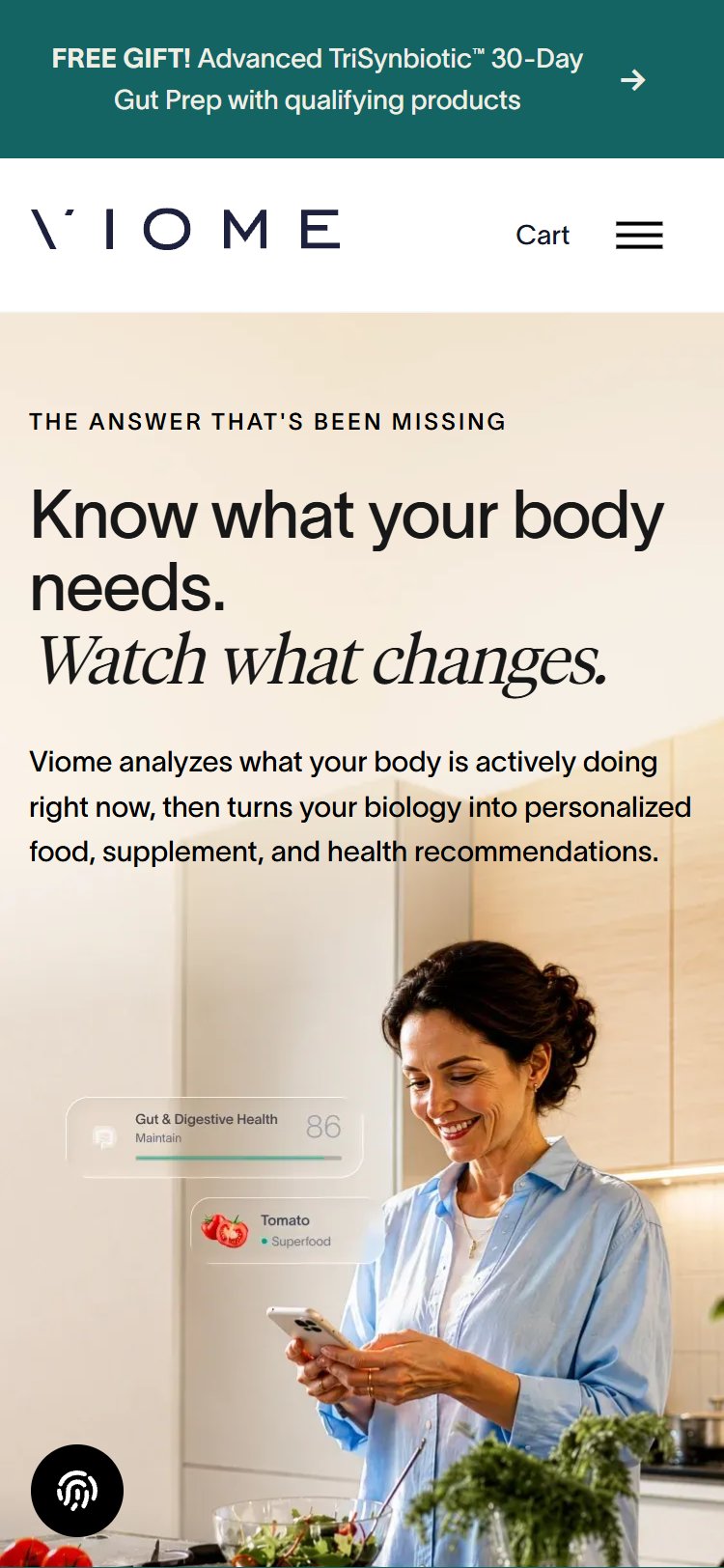
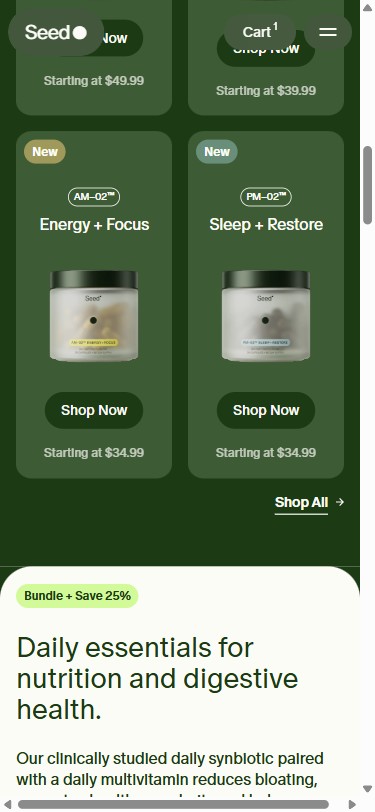
- Scrolling through the full homepage reveals no product card grid, no bestsellers row, no 'Shop Our Tests' section with product images, names, and prices.
- The only product navigation is via the announcement bar CTA or the hamburger menu — both require active user intent. Passive browsers see brand messaging but cannot discover or click a product.
- 80% of health and wellness brands include a bestsellers or featured products section with 2-4 product cards on the homepage, enabling direct ATC or PDP navigation without menu interaction.
Recommendations
- Add a 'Our Tests' or 'Start With Your Goals' section midway through the homepage with 3 product cards (Full Body Intelligence, Gut Intelligence, Oral Health) showing product image, headline benefit, price, and a 'Shop Now' button.
- Include subscription price callout (e.g. 'From $299 / one-time') on each card to set pricing expectations before the PDP.
No search bar in header — users cannot locate specific tests or supplements by keyword
Observations
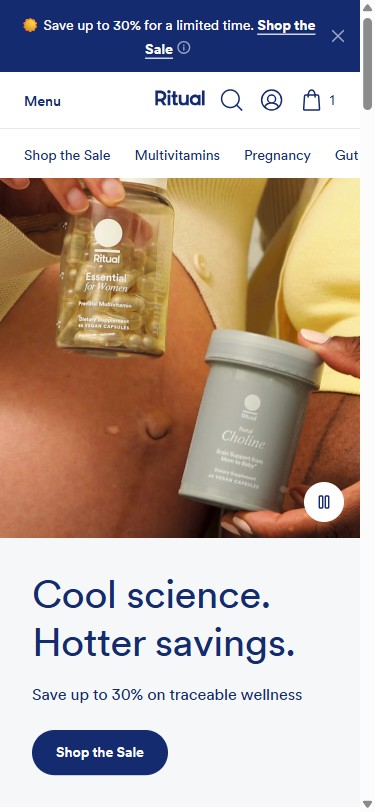
- The mobile header contains only the Viome logo, a 'Cart' button, and a hamburger menu — no search icon or input field is present.
- Viome's catalog includes tests, personalized supplements, biotics, oral care, and cancer detection products. Users looking for a specific product type must navigate the menu hierarchy or scroll the homepage.
- For a brand whose value proposition is personalization, removing search prevents users from self-directing to their condition of interest (e.g. searching 'bloating', 'brain fog', or 'gut test').
Recommendations
- Add a search icon to the mobile header (next to the cart icon) that expands to a full-width search input with predictive suggestions for product names and health concerns.
- Implement concern-based search suggestions — typing 'bloating' should surface the Gut Intelligence Test and relevant supplement products.
Product cards have no star ratings — social proof absent at the browse and comparison stage
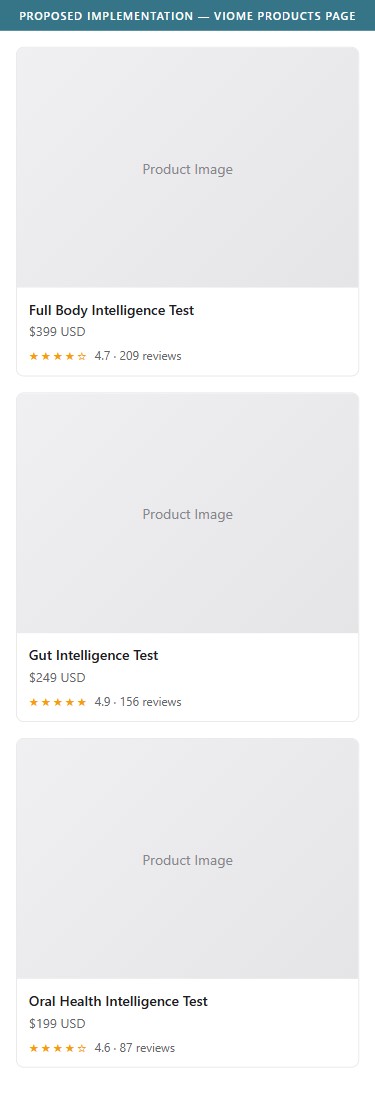
Observations
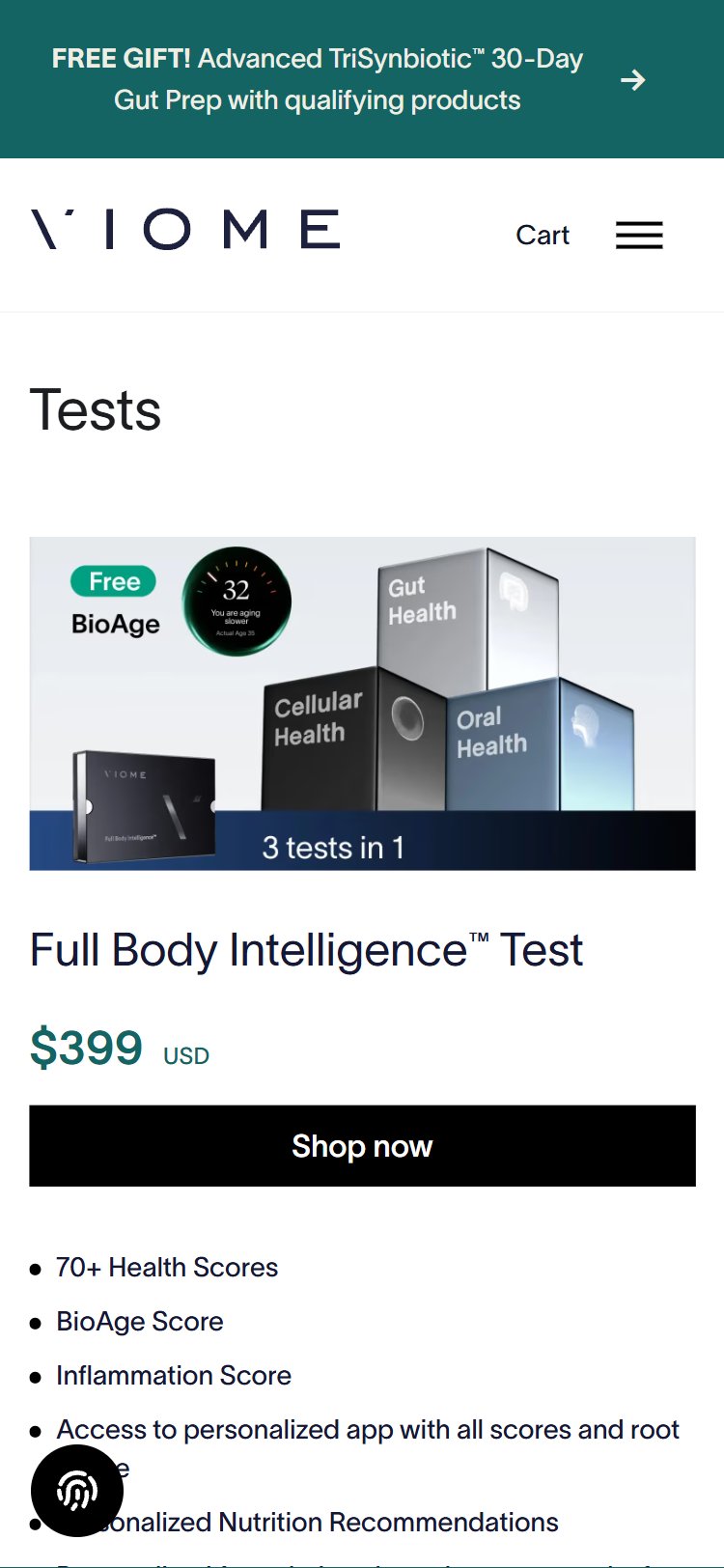
- All product cards on the /products collection page display product image, name, and price — but no star rating, review count, or social proof indicator.
- The Full Body Intelligence Test has 209 reviews with a 4.7 average rating on its PDP. This signal is completely hidden from users comparing products on the collection page.
- 70% of health and wellness brands display star ratings on collection product cards. Removing them at this decision stage forces extra clicks and slows conversion.
Recommendations
- Add a star rating line (e.g. ★★★★☆ 4.7 · 209 reviews) below the product name on each product card, linking to the reviews section on the PDP.
- For newer products with fewer reviews, display a review count to signal authenticity rather than hiding the widget.
No filter bar on products page — users cannot sort or narrow by health goal, price, or type
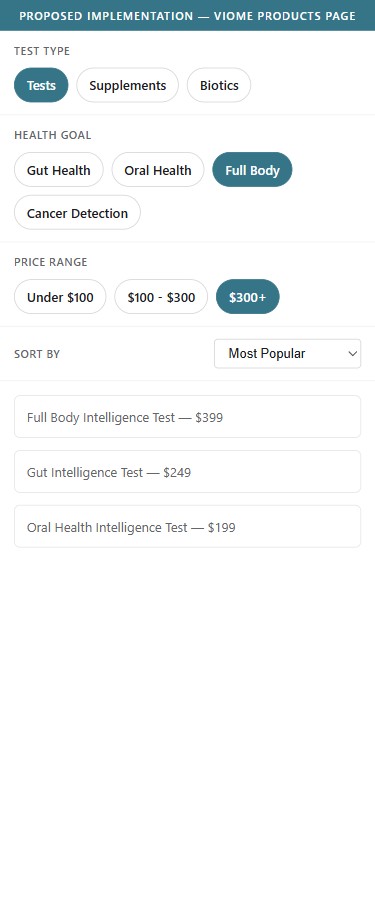
Observations
- The /products page lists all tests and supplements as a linear scroll with no sort dropdown, no filter sidebar, and no sticky filter bar.
- Viome serves distinct user intents: users focused on gut health, oral health, cancer screening, or full-body analysis need different entry points. With no filters, all user types see the same undifferentiated list.
- The lack of filtering is especially costly on mobile where product cards require significant scrolling — users cannot jump to their relevant category.
Recommendations
- Add a horizontal pill-style filter row at the top of the products page with filters for: Test Type (Tests / Supplements / Biotics), Health Goal (Gut Health / Oral Health / Cancer Detection / Full Body), and Price Range.
- Include a sort dropdown ('Most Popular', 'Price: Low to High', 'Newest') alongside the filters.
Subscription pricing absent from product cards — users hit sticker shock at PDP
2 products
🌱
Seed
DS-01™ Daily Synbiotic
★★★★★ 4.9 · 12,400 reviews
Subscribe: $38/mo
One-time: $49.99
Save 15% with subscription
🌸
Seed
PDS-08™ Pediatric Daily Synbiotic
★★★★★ 4.8 · 3,200 reviews
Subscribe: $28/mo
One-time: $34.99
Save 15% with subscription
Seed — subscription price shown on collection card
Observations
- Product cards on the collection page show only the one-time purchase price (e.g. '$399 USD' for Full Body Intelligence Test) with no subscription or subscribe-and-save price shown.
- US health brands that offer subscriptions show the subscription price on collection cards (e.g. 'From $38/mo') to anchor value expectation early in the funnel.
- Users who see '$399' on the collection page without context may bounce before reaching the PDP where the subscribe-and-save option (if any exists) would be shown. Viome currently has no subscribe-and-save on the test PDP — a separate but compounding issue.
Recommendations
- If Viome offers supplement subscriptions, display the monthly subscription price on supplement product cards (e.g. 'From $79/mo') as a secondary price below the one-time price.
- For test kits, add 'HSA/FSA eligible — save up to 30%' as a sub-label on the card to soften the price perception without misrepresenting the product type.
No Subscribe & Save option on PDP — 100% of US health brands pre-select subscription to anchor recurring revenue
DS-01™ Daily Synbiotic
$49.99
Subscribe & Save 15%
$49.99/mo · cancel anytime
You save $8.50/mo
One-time purchase
$58.50
Add to Cart
✓ Free shipping · ✓ Cancel anytime · ✓ Science-backed
Seed — subscribe pre-selected with savings callout
Observations
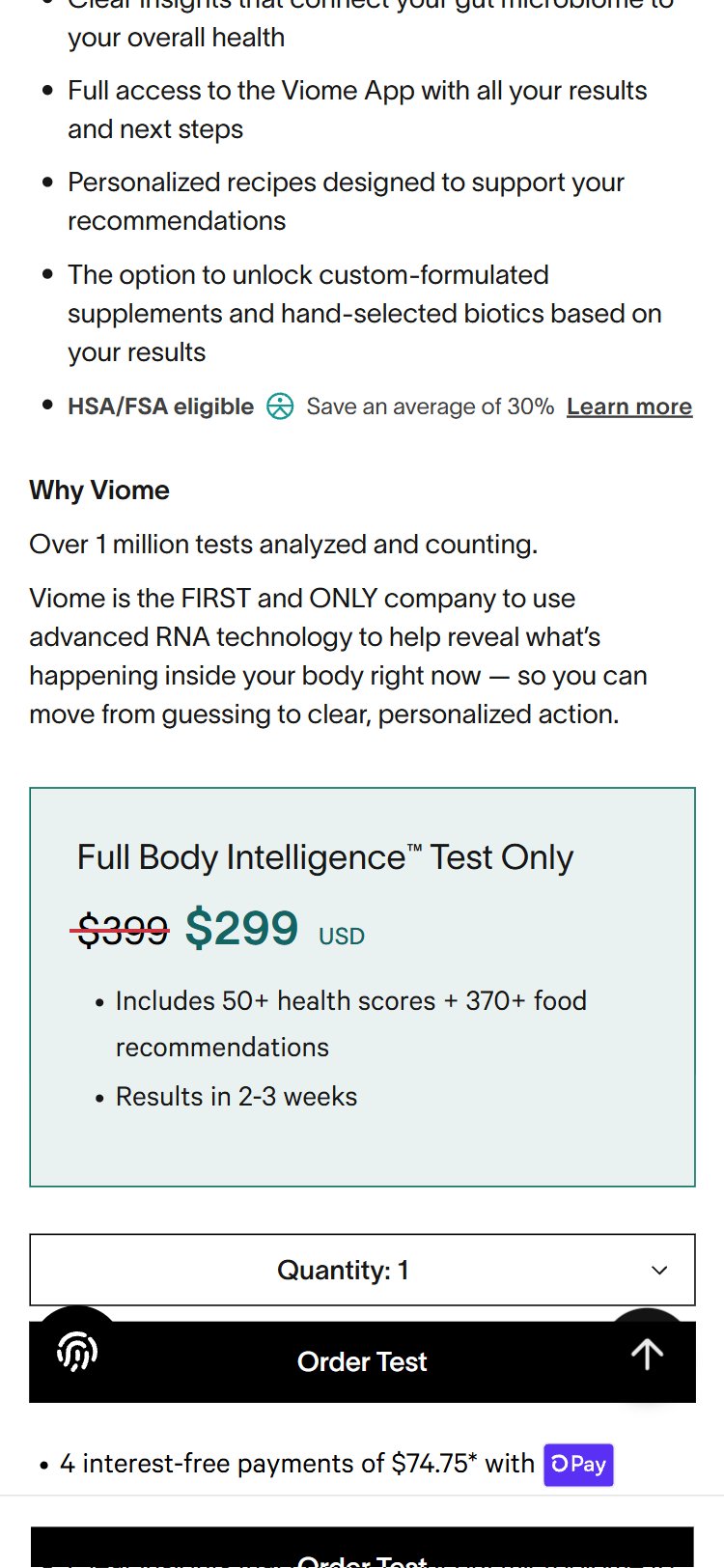
- The Full Body Intelligence Test PDP has a single purchase option with a quantity dropdown and an 'Order Test' button — no subscription toggle, subscribe-and-save radio button, or recurring delivery option exists.
- All 5 sampled US health and wellness brands pre-select subscription on their PDP with a clearly visible savings callout (e.g. Seed: 'Subscribe & save 15% — $49.99/mo, cancel anytime'). This is considered a baseline expectation for the category.
- Viome does offer personalized supplements on subscription (referenced in footer disclaimer), but this upsell never appears in the test product purchase flow, leaving significant LTV on the table.
Recommendations
- Add a one-time vs. subscribe-and-save radio selector above the 'Order Test' button, with subscription pre-selected and a savings callout badge (e.g. 'Subscribe & Save 15% — cancel anytime').
- For the test kit specifically, offer a retest subscription (6-month or 12-month retest reminder with discounted retest pricing) as the subscribable option — aligned with Viome's existing 'Discounts on retests' benefit listed on product cards.
No certification badges near ATC — trust signals absent at the purchase decision moment
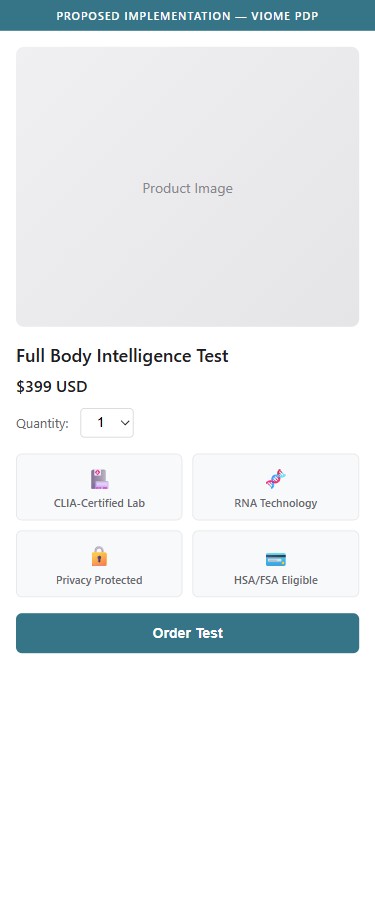
Observations
- The ATC zone on the Full Body Intelligence Test PDP shows price, quantity selector, 'Order Test' button, and a BNPL line (4 interest-free payments with DPay) — but no certification badges are present between the price and the button.
- Viome's credibility is built on lab-grade science (CLIA-certified lab, RNA sequencing, peer-reviewed research), yet none of these credentials are rendered visually near the buy button where purchase anxiety peaks.
- 80% of US health brands display 2-5 certification badges (e.g. Non-GMO, Third-Party Tested, GMP Certified, Clinically Tested) within 200px of the ATC button.
Recommendations
- Add a horizontal row of 4-5 badge icons between the quantity selector and the 'Order Test' button: CLIA-Certified Lab, RNA Technology, Privacy Protected, HSA/FSA Eligible, and 30-Day Money-Back Guarantee.
- Use compact icon+label badges at 14px, not full-width banners — they should reinforce without competing with the CTA.
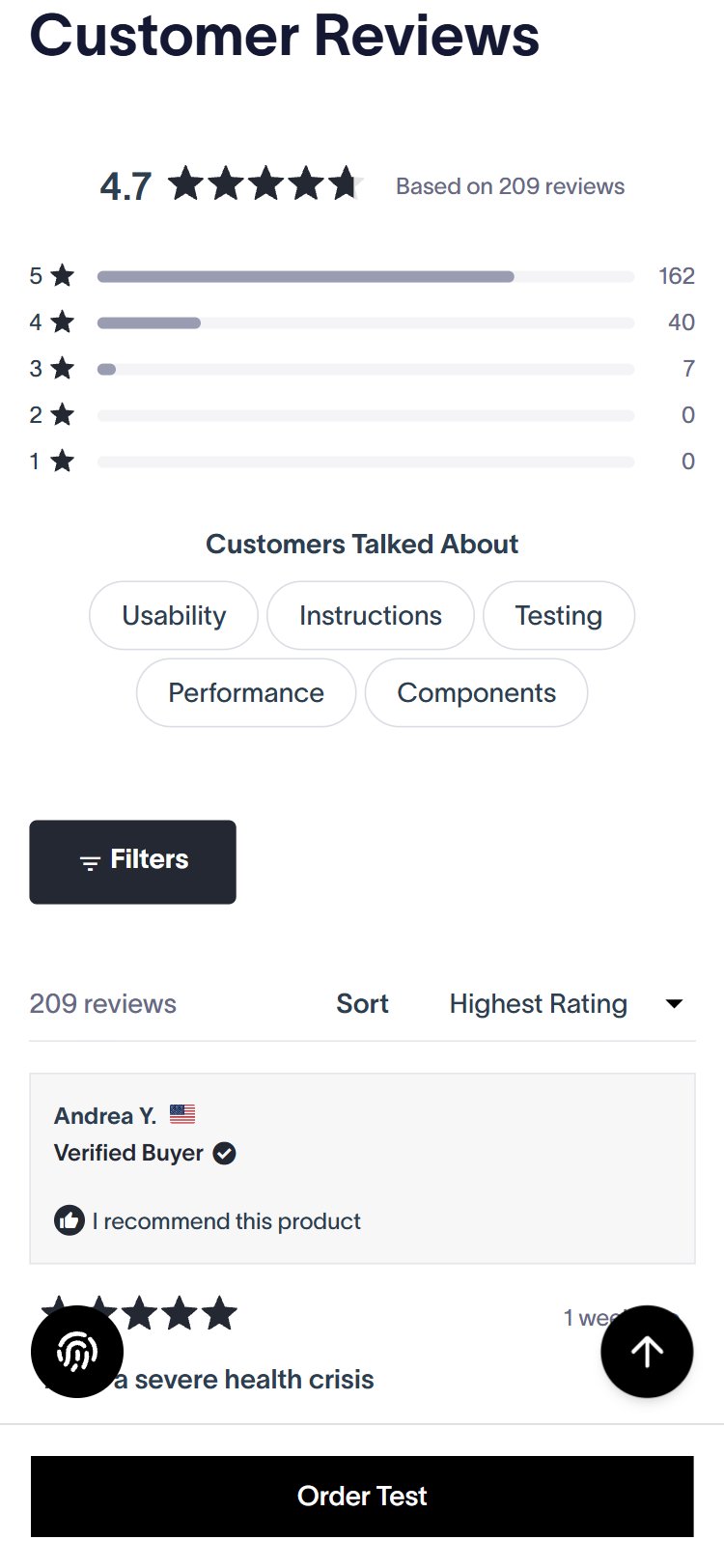
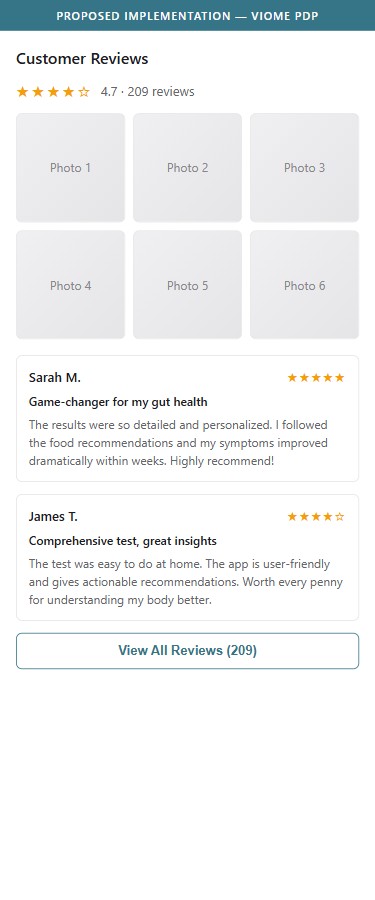
Reviews are text-only — no customer photos or UGC in reviews section
Observations
- The Customer Reviews section (powered by Okendo, 4.7 stars, 209 reviews) displays text-only reviews. No customer-uploaded photos or videos are present in any review card.
- The Okendo platform supports photo and video UGC reviews — the feature appears to be disabled or no photo upload prompts were included in review request emails.
- Visual UGC (before/after photos, lifestyle shots of the kit, screenshots of app results) is especially powerful for a health diagnostic brand where tangible 'proof of change' is the core value proposition.
Recommendations
- Enable photo and video upload in Okendo review request emails, explicitly prompting customers to share screenshots of their health score results, their personalized food list, or their supplement delivery.
- Display a media gallery above the text reviews showing all customer-submitted photos in a tappable grid — prioritizing photos that show the app results dashboard.
No related products section on PDP — zero cross-sell path to supplements or other tests
Complete Your Health Plan
Customers who ordered this also added…
🌿
Precision Supplements
From $79/mo
+ Add
🦠
VRx My-Biotics Gut Formula
$89/mo
+ Add
🦷
VRx Oral Lozenges
$59/mo
+ Add
View all recommendations →
Cross-sell carousel below reviews — 2–3 cards with direct ATC
Observations
- The Full Body Intelligence Test PDP ends after the customer reviews section with no 'You May Also Like', 'Frequently Bought Together', or 'Complete Your Plan' product recommendation section.
- Viome has a natural cross-sell opportunity: users buying a Gut Intelligence Test could be shown Precision Supplements or VRx My-Biotics. Users buying the Full Body Test could be shown the Cancer Detect product.
- Absence of related products creates a dead-end UX — users who finish browsing the PDP must navigate back to the menu to explore additional products.
Recommendations
- Add a 'Complete Your Health Plan' carousel below the reviews section showing 2-3 complementary products (e.g. personalized supplements, VRx biotics) with brief benefit lines and direct ATC buttons.
- Frame recommendations contextually: 'Customers who ordered this test also added...' to leverage social proof alongside product discovery.
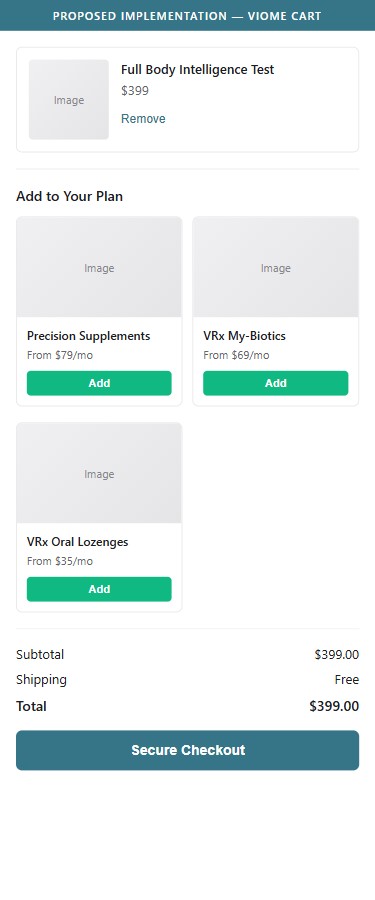
No cross-sell or upsell in cart drawer — zero incremental revenue captured post-ATC
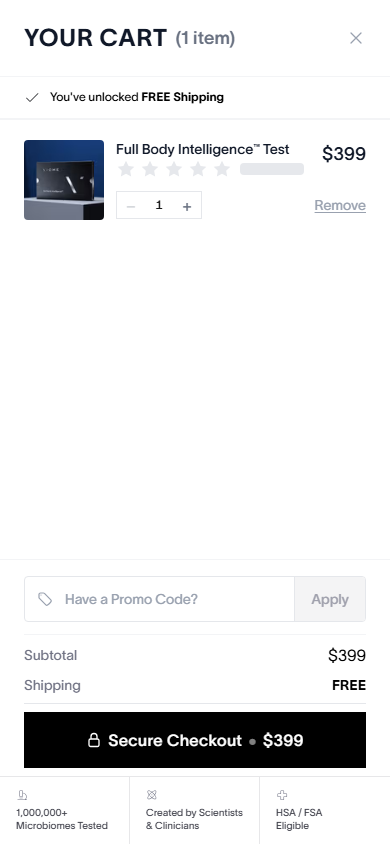
Viome cart — actual mobile screenshot
Observations
- After adding the Full Body Intelligence Test to cart, the cart drawer shows the item, a BioAge Score free gift, a promo code field, and a price breakdown — with no product recommendation section anywhere in the drawer.
- Viome's supplement and biotics products are natural additions to a test kit purchase (users will need supplements once they get results). The cart is the highest-intent moment to suggest these adjacent products.
- Industry standard (CART-01) requires at least one product recommendation section in the cart. Absence means every cart interaction is a single-item checkout with no upsell attempt.
Recommendations
- Add a 'Add to your plan' row at the bottom of the cart drawer with 2-3 product cards for Precision Supplements, VRx My-Biotics Gut Formula, and VRx Oral Lozenges — all at their subscription price to anchor recurring revenue.
- Use a one-click add mechanic on cart recommendation cards (no PDP navigation required) to minimize checkout flow disruption.
No express checkout options — only standard 'Secure Checkout' button, missing Shop Pay, Apple Pay, Google Pay
Viome cart — actual mobile screenshot
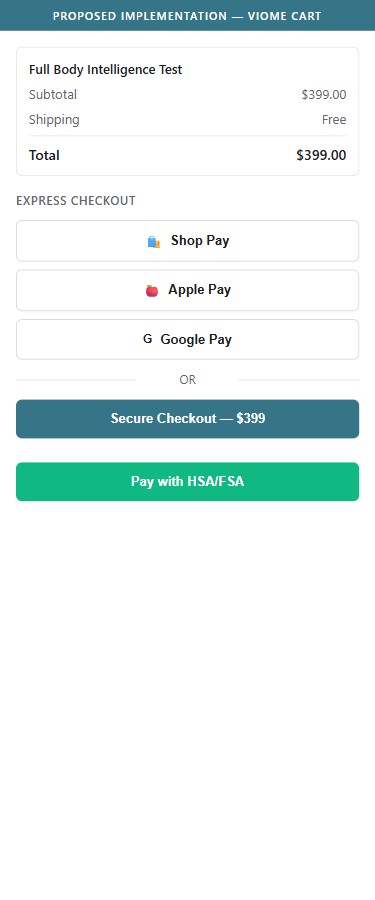
Observations
- The cart drawer checkout area contains a single 'Secure Checkout • $399' button with a lock icon. No Shop Pay, Apple Pay, Google Pay, or PayPal express checkout buttons are present.
- At $399, Viome's test kit is a high-consideration purchase. Express checkout options reduce the checkout steps from 4-6 (manual form fill) to 1-2 (biometric confirm), meaningfully reducing abandonment for mobile-first buyers.
- 60% of US D2C brands at this price point offer at least one express checkout option in the cart.
Recommendations
- Add Shop Pay, Apple Pay, and Google Pay express checkout buttons above the standard 'Secure Checkout' button in the cart drawer — styled as secondary buttons with brand logos.
- For HSA/FSA purchases, surface a dedicated 'Pay with HSA/FSA' button (via TrueMed, which is already detected on the site) directly in the cart to capture this segment without requiring users to navigate away.
04
Technology Ecosystem
Technology stack assessment — installed tools vs recommended additions for Next.js stores
Present (13)
Klaviyo
Email & SMS Marketing
Okendo
Reviews & UGC
Mouseflow
Behavioral Analytics
Northbeam
Multi-Touch Attribution
TrueMed
HSA/FSA Payments
Ketch
Consent Management
UserWay
Accessibility
Meta Pixel
Paid Social Advertising
TikTok Pixel
Paid Social Advertising
Pinterest Tag
Paid Social Advertising
Impact
Affiliate Marketing
Google Analytics 4 + GTM
Web Analytics
DPay (BNPL)
Buy Now Pay Later
Missing (6)
Subscription Management (Recharge / Ordergroove) Critical
Subscriptions & Recurring Revenue
💰 Recurring revenue uplift 20-35% LTV
100% of US health brands offer Subscribe & Save on consumable products; 0 subscription toggle detected on Viome PDPs
Post-Purchase Upsell (ReConvert / Rebuy) Critical
Upsell & Cross-sell
💰 AOV lift 8-15% per transaction
80% of US D2C health brands use in-cart or post-purchase upsell for complement products
Live Chat / Helpdesk (Gorgias / Intercom) Critical
Customer Support
📈 Reduces pre-purchase drop-off by 10-20%
70% of health brands at $250+ AOV offer live chat to address test/result questions that block purchase
Loyalty & Rewards (Smile.io / LoyaltyLion) Critical
Retention & Loyalty
🔄 Repeat purchase rate uplift 15-25%
60% of US health brands at this tier use a points/rewards program to incentivize retests and supplement reorders
Urgency & Social Proof (CartTimer / Sales Notification) Critical
Conversion Optimization
📈 Cart abandonment reduction 5-12%
65% of health e-commerce brands display urgency signals (low stock, time-limited offer, recent purchases) in cart
Microsoft Clarity or Hotjar Opportunity
Behavioral Analytics
📈 Free funnel drop-off visibility
Mouseflow is present but Clarity (free) provides rage-click and dead-click heatmaps as complementary diagnostic layer
App Stack Assessment
13 apps detected, 6 critical gaps identified
Confidential — Prepared for Viome by Growisto | June 2026