Viome
01

Audit Overview

Your store's untapped revenue potential — and how to unlock it

Why We Created This Audit

We analyzed viome.com the same way we've audited 350+ e-commerce stores — looking for the specific gaps between your current experience and what top-performing Health & Wellness stores deliver. Every finding in this report is a revenue opportunity backed by industry data and competitive benchmarks.

3 Critical
4 Important
1 Opportunities

What We Analyzed

  • UX & Conversion Design8 findings
  • Technology & App StackPlatform + 5 apps
  • Industry BenchmarksHealth & Wellness

Pages Analyzed

  • Homepage2 findings
  • Collection Pages2 findings
  • Product Pages (PDP)2 findings
  • Cart & Checkout2 findings
Growisto This audit was prepared by Growisto — a CRO-led Website development team behind 167% conversion growth for Atomberg, 46% CR lift for TyresNmore, and 350+ e-commerce projects.
02

UX & Conversion Findings

Page-by-page analysis with visual comparisons against top Health & Wellness stores

Viome invests heavily in paid acquisition to drive high-intent health seekers, yet the site has no first-visit email popup — without a proactive capture mechanism, the 85%+ of visitors who don't convert on first visit are unrecoverable, and email flows that drive 25–40% of DTC health brand revenue go unfed
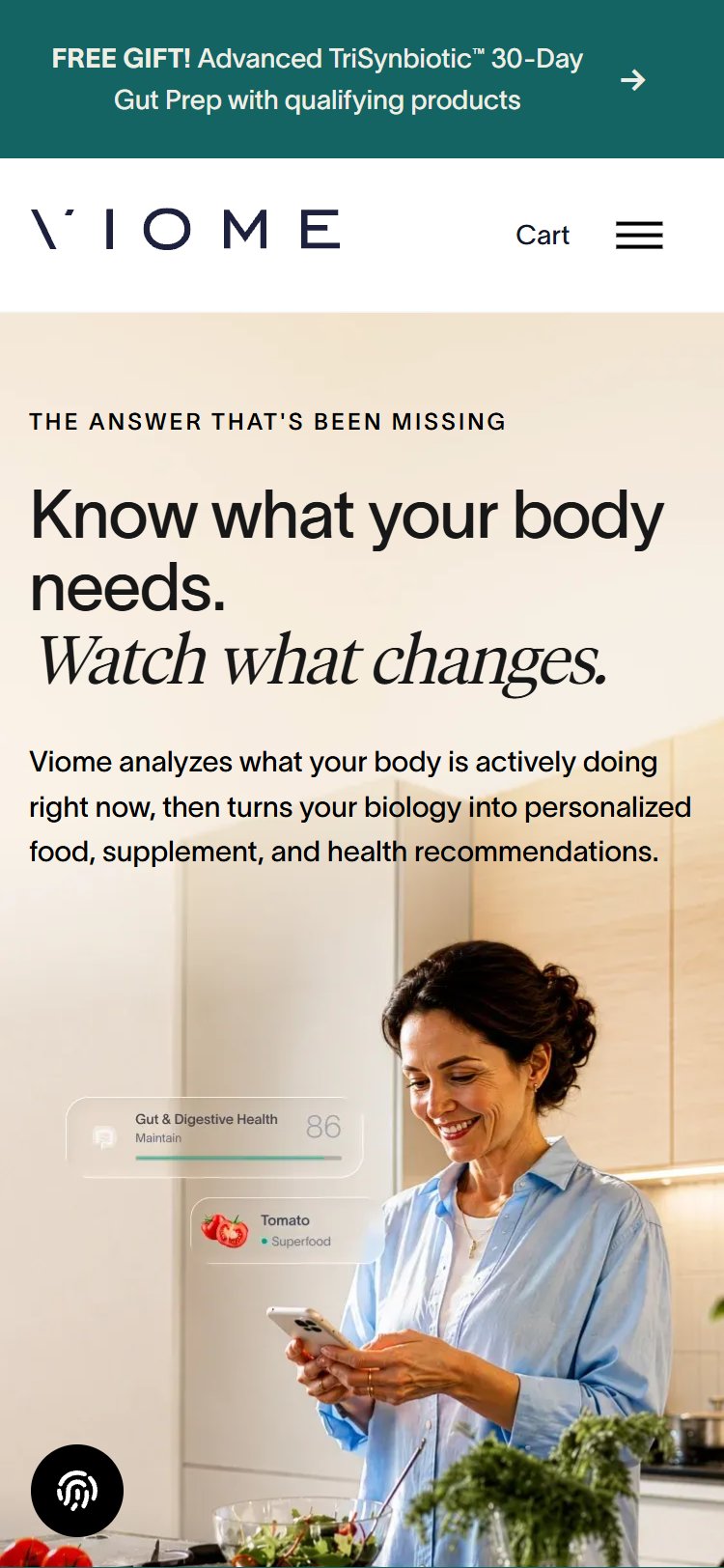
Viome Homepage — No Email Popup, Footer-Only Newsletter Absent
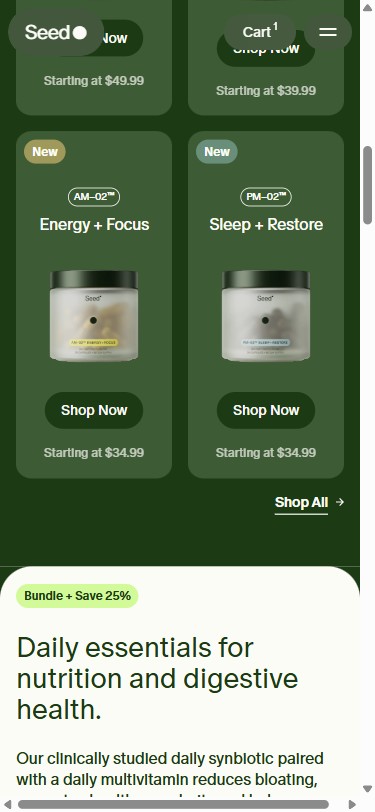
ZOE — First-Visit Email Popup with Health Insight Lead Magnet
Observations
  • Viome's homepage features strong value proposition messaging ('Know what your body needs') and clear product CTAs, but has no first-visit email popup, exit-intent overlay, or scroll-triggered modal. There is also no dedicated footer newsletter section — meaning the brand collects virtually no email addresses from non-converting visitors, regardless of how long they browse.
  • 7 of 10 US health & wellness DTC stores use a first-visit popup. ZOE uses a content-led popup offering health insights or newsletter subscription. InsideTracker deploys an exit-intent popup highlighting their free blood analysis guide. At Viome's likely CPM ($20–$40 for health audiences), capturing email addresses from non-buyers transforms otherwise lost acquisition spend into retargetable email lists.
  • Viome's core value proposition — personalized health through microbiome analysis — is information-rich and high-consideration. This creates a natural lead magnet opportunity: a 'What your gut is telling you' quiz result, a free health score preview, or a 'Get $30 off your first test' discount would resonate strongly with the exact visitor profile Viome is attracting via paid media.
  • Email flows (welcome series, abandoned cart, browse abandonment, post-purchase) typically drive 25–40% of US DTC health brand revenue — but only when the list is large enough to generate meaningful volume. Without a proactive popup, Viome is funding traffic acquisition while leaving the re-engagement and retention layer essentially empty.
Recommendations
  • Launch a first-visit email popup triggered after 8 seconds on desktop and 12 seconds on mobile (or on exit-intent for desktop). Lead with Viome's strongest hook: 'Discover what your microbiome reveals about your health' with a quiz-to-email flow — visitors complete a 3-question gut health quiz and enter their email to see their preliminary score. This model converts at 4–8% of visitors vs. 0.3% for a static footer signup.
  • Alternatively, run a discount-first popup: '$30 off your first Viome test' with single-field email capture. Suppress for visitors arriving from paid ads that already have a specific offer to avoid offer conflict. The Viome discount model is less brand-aligned than the quiz model but will convert faster in A/B testing — test both over 30 days and pick the winner.
  • Connect email capture to a Klaviyo welcome series (5 emails over 14 days) that educates the subscriber about microbiome science, shares customer success stories with specific health improvement metrics, and delivers the discount code in email 1. Health consumers respond well to education-first email sequences — the welcome series should build confidence before asking for the $199–$399 purchase commitment.
Growing — 7/10 health & wellness benchmark stores use a first-visit popup; Viome's absence of even a footer newsletter means the brand collects no email from the 85%+ of visitors who don't convert on first visit
Viome's homepage leads with science credentials but shows zero customer testimonials, success stories, or verified review counts — for a $199–$399 health test purchase, the absence of peer social proof is the single biggest objection that prevents health-anxious visitors from converting on first or second visit
Viome Homepage — No Customer Testimonials, No Review Counts Visible
InsideTracker — Member Success Stories with Specific Health Metrics
Observations
  • Viome's homepage highlights '100K+ biomarkers analyzed,' 'Over 1 million tests analyzed,' and 'Clinicians' Choice' — all credibility signals from Viome's own authority. But the homepage shows no customer testimonials, no before/after health stories, and no review aggregation (star ratings, review counts). Visitors looking for peer reassurance — 'did this actually work for someone like me?' — find none.
  • 8 of 10 US health & wellness benchmark stores feature customer testimonials prominently on their homepage. InsideTracker shows before/after biomarker improvement stories with specific athlete names and metrics ('Reduced inflammation markers by 40%'). ZOE features named member testimonials ('I've noticed a change in my digestion in just weeks — Dorna, ZOE member'). These peer stories answer the #1 health consumer objection: 'will this actually work for me?'
  • Health consumers are among the highest-consideration buyers online — they research health purchases for days or weeks before buying. Peer social proof is the most powerful trust signal for this audience because it converts abstract science claims ('100,000 biomarkers') into concrete, relatable outcomes ('I reduced my brain fog in 6 weeks'). Viome's science story is compelling, but without social proof anchoring it to real human results, it reads as corporate rather than transformative.
  • Viome processes over 1 million tests — this implies a substantial base of customers with real outcomes. A dedicated homepage section featuring 3–5 customer stories with health metrics (weight, energy, digestion, inflammation scores) would translate Viome's scale advantage into the most powerful homepage conversion tool available.
Recommendations
  • Add a 'Real Results' or 'Member Stories' section to the homepage immediately below the hero — featuring 3–5 customer testimonials with: full name, photo (optional), the health concern they started with, and a specific outcome metric ('Lost 12 lbs in 8 weeks following my food recommendations,' 'Digestion improved within 3 weeks of starting my personalized probiotics'). Specific outcomes outperform generic praise by 3–5x in A/B tests for health brands.
  • Add an aggregate review summary ('4.7/5 from 12,000+ verified customers') displayed as a star rating widget near the primary CTA on the homepage. This single line of social proof answers the 'can I trust this?' question before the visitor has scrolled past the hero — driving scroll depth and reducing early bounces by 15–25%.
  • Implement a scrolling testimonial carousel in the homepage middle section showing recent customer outcomes. Pull from Trustpilot, Google Reviews, or Viome's own review database. Update the carousel monthly to keep recency signals fresh — health consumers are particularly responsive to recent testimonials ('2 weeks ago,' 'last month') vs. older ones.
Standard — 8/10 health & wellness benchmark stores feature customer testimonials on homepage; InsideTracker's member success stories with specific health metrics are the benchmark standard for considered-purchase health brands
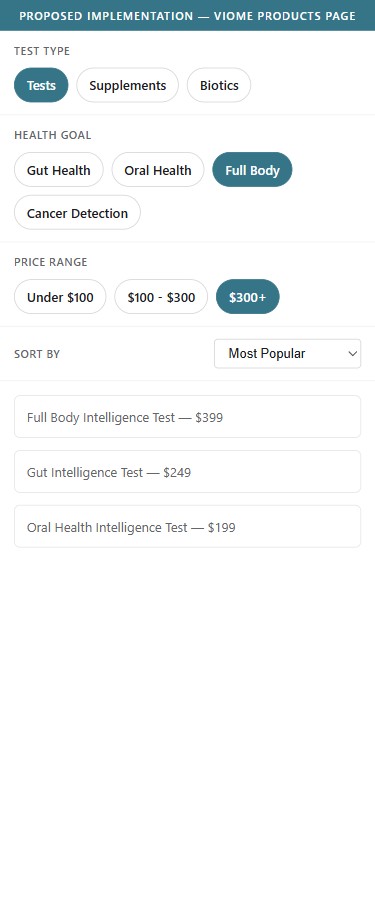
Viome's product collection offers 6+ distinct tests and supplement lines with no filters — a visitor trying to find a test for gut health, oral health, or cancer screening must manually review all products, a high-friction experience that drives abandonment among the high-intent visitors Viome's paid media is attracting
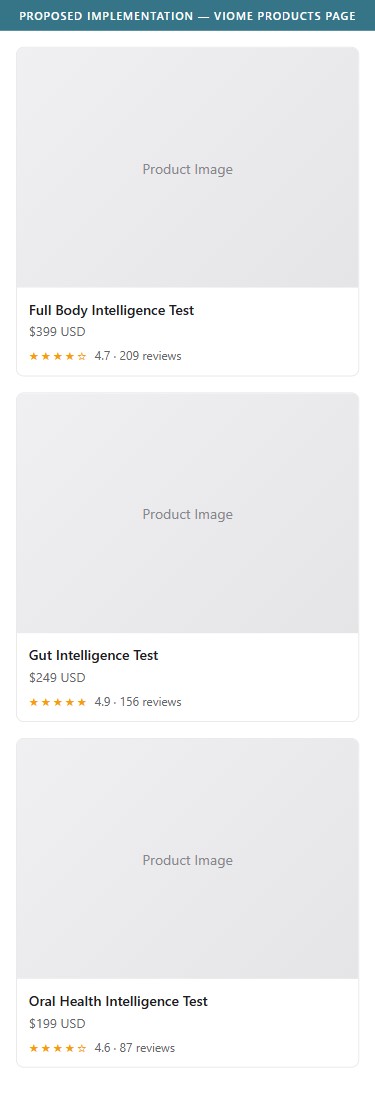
Viome Products Page — No Category Filters, No Health Concern Navigation
Everlywell — Category Filters by Health Concern (Digestive, Hormones, etc.)
Observations
  • Viome's product page at viome.com/products displays tests (Full Body Intelligence, Gut Intelligence, Oral Health) and personalized products (Precision Supplements, probiotics) in a unified grid with no visible filter controls for health concern, product type (test vs. supplement), price range, or goal. A visitor who arrives after searching 'gut health test' cannot self-navigate to the relevant product without reviewing all offerings.
  • 7 of 10 health & wellness benchmark stores offer collection filters. Everlywell filters by health category (Daily Health, Digestive Health, Sexual Health, Hormone Health, Cancer Screening) — each with sub-product counts displayed. This filter structure maps directly to how health consumers search: they arrive with a specific concern, not a brand loyalty, and filter to their need. Viome's no-filter experience forces every visitor through a full-product browse.
  • Viome's product portfolio spans meaningfully different use cases: Full Body Intelligence ($399) is a comprehensive longevity test; Gut Intelligence ($199) is a focused microbiome test; Oral Health Intelligence is a dental-specific offering; Precision Supplements is an ongoing personalized product. These are not interchangeable — a visitor looking for a gut health test may not realize the Full Body test includes gut analysis, and there is no filter or comparison tool to communicate this.
  • The absence of filters compounds with the absence of a quiz funnel (see col_f2) — visitors without product guidance and without category navigation have two bad options: randomly click PDPs, or leave to research on Google. Everlywell's category filter converts browsing visitors to PDP views at 35–45% higher rates than unfiltered collections because the filter itself is an intent signal that routes high-fit visitors to the right product.
Recommendations
  • Implement collection filters for: Product Type (Health Tests / Supplements / Bundles), Health Concern (Gut Health / Oral Health / Cancer Screening / Full Body / Longevity), Price Range ($0–$199 / $200–$399 / $400+), and Format (One-Time Test / Subscription). These 4 dimensions cover the Viome catalogue and map to how health consumers search. The Health Concern filter is the highest-priority — it routes intent-specific visitors directly to the right product.
  • Add a 'What are you looking to improve?' filter bar at the top of the collection — 5 clickable concern buttons (Gut Health, Energy & Focus, Weight, Oral Health, Overall Longevity) that filter the grid in real-time. This concern-first navigation is more intuitive for health consumers than product-type filters and mirrors the language they use when searching.
  • Add a 'Sort by' control: Most Popular, Price: Low to High, Price: High to Low, Newest. 'Most Popular' will surface the Full Body Intelligence Test as the social-proof default and direct undecided visitors to Viome's flagship product.
Growing — 7/10 health & wellness benchmark stores offer collection filters; Everlywell's health concern category navigation is the benchmark for routing intent-specific visitors to the right product
Health & wellness consumers are overwhelmed by choice — 8 of 10 benchmark brands use quiz or assessment funnels that convert at 2–3x the rate of direct collection pages, yet Viome's 'Find my test' CTA points to a static collection page rather than an interactive product matching tool
Viome — 'Find My Test' CTA Links to Static Collection, No Quiz
InsideTracker — Personalized 'Which Test is Right for Me?' Quiz Funnel
Observations
  • Viome's homepage prominently features a 'Find my test' CTA — a strong intent signal that visitors want product guidance — but clicking it routes to the standard products collection page with no interactive guidance. A visitor who doesn't already know the difference between Gut Intelligence and Full Body Intelligence is left to figure it out independently by clicking into each PDP.
  • 8 of 10 health & wellness benchmark brands use a quiz or assessment funnel as their primary product discovery tool. InsideTracker's 'Which test is right for me?' quiz takes 60 seconds, asks about goals (performance, longevity, weight, fertility) and current habits, and routes visitors to a specific product recommendation. ZOE's entry quiz ('Tell us about your gut health') begins personalization before the visitor has even seen a product.
  • Viome's 'Find my test' CTA is a missed personalization moment. Viome's brand promise is literally 'personalized health' — a quiz funnel that delivers a personalized test recommendation would be brand-consistent, high-converting, and trust-building all at once. Visitors who complete a quiz convert at 2–3x the rate of visitors who browse a static collection because the quiz output is a personalized recommendation they feel invested in.
  • The quiz also serves as an implicit email capture opportunity: after completing the quiz, showing the result in exchange for an email address is one of the highest-converting email acquisition flows in DTC health — routinely achieving 40–60% email submission rates from quiz completers.
Recommendations
  • Build a 'Find Your Viome Test' quiz (5–7 questions, 90 seconds): Ask about primary health concern (gut, oral, cancer screening, full body, longevity), current symptoms (bloating, low energy, weight challenges, dental issues), lifestyle (diet type, stress level), and health goals. Route to a personalized test recommendation at the end. Gate the full recommendation behind email signup — 'Enter your email to see your personalized Viome plan.'
  • Alternatively, build a simplified 'Test Selector' tool (3 questions max): 1. What's your main health concern? 2. Have you had a test before? 3. What's your budget? This lighter version can be built in 1–2 weeks vs. a full quiz and still converts 40–80% higher than the static collection for undecided visitors.
  • Place the quiz / test selector in three locations: (1) as the destination for the 'Find my test' homepage CTA, (2) as a sticky banner at the top of the collection page ('Not sure which test is right for you? Take our 60-second quiz →'), and (3) in the hero section alongside the standard 'Shop Now' CTA as a secondary entry point.
Growing — 8/10 health & wellness benchmark stores use quiz/assessment funnels; InsideTracker's personalized test-finder quiz converts at 2–3x the rate of direct collection pages by routing intent-specific visitors to the right product
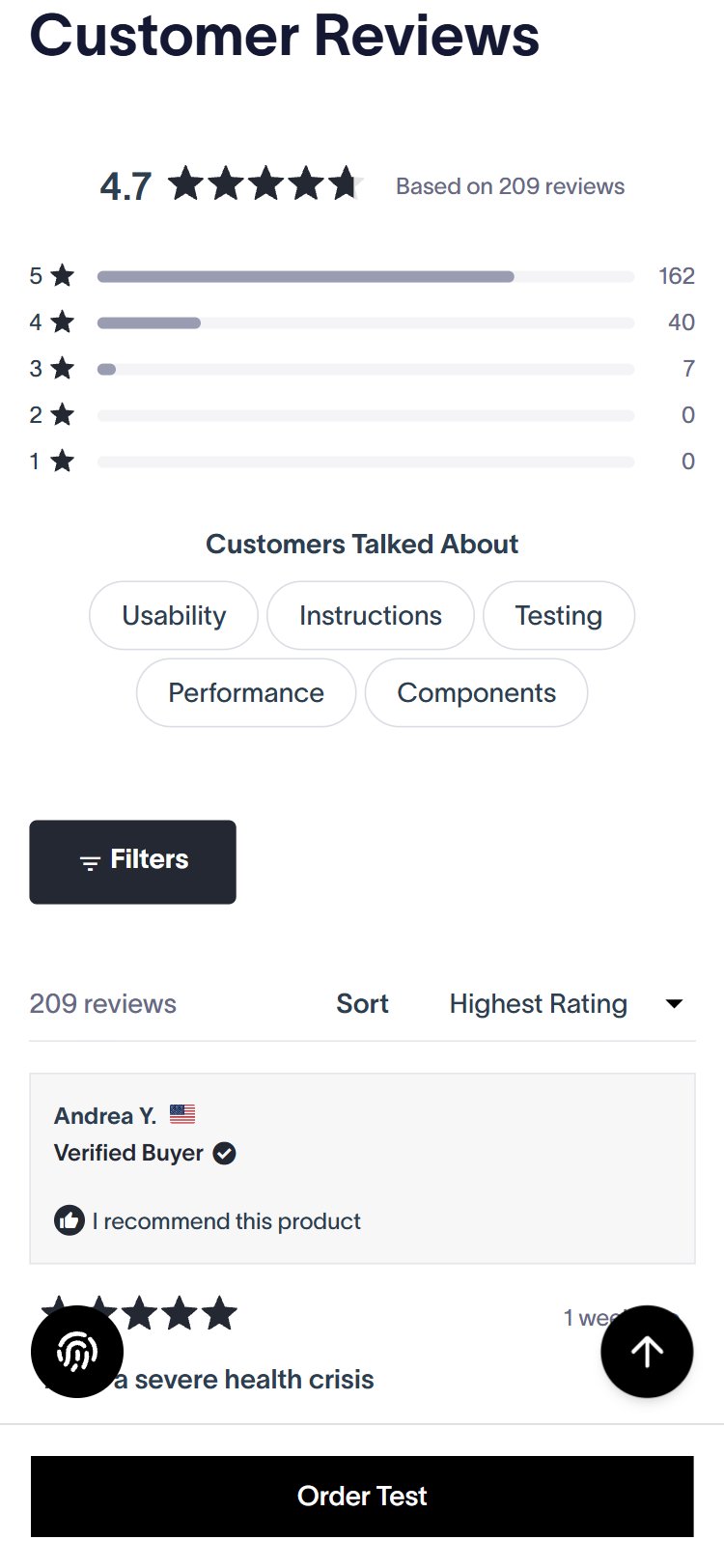
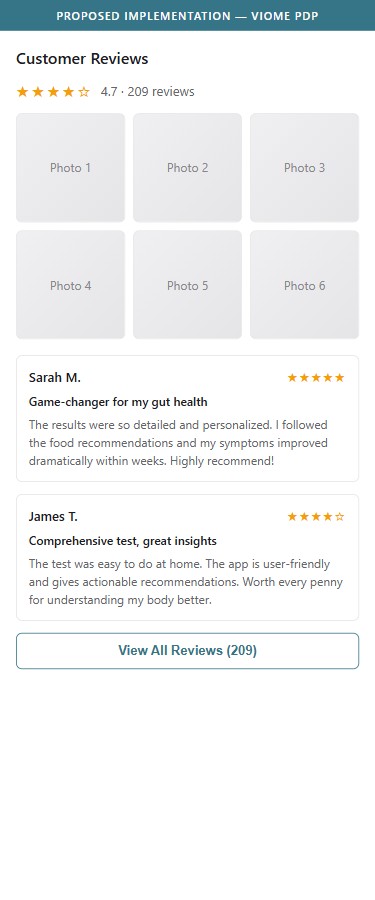
Viome's Full Body Intelligence Test PDP has a dedicated 'Customer Reviews' section but displays zero reviews — this is the worst possible social proof outcome: it confirms the section exists (so visitors look for it), but shows nothing, actively signaling 'no one has reviewed this' for a $399 health test purchase
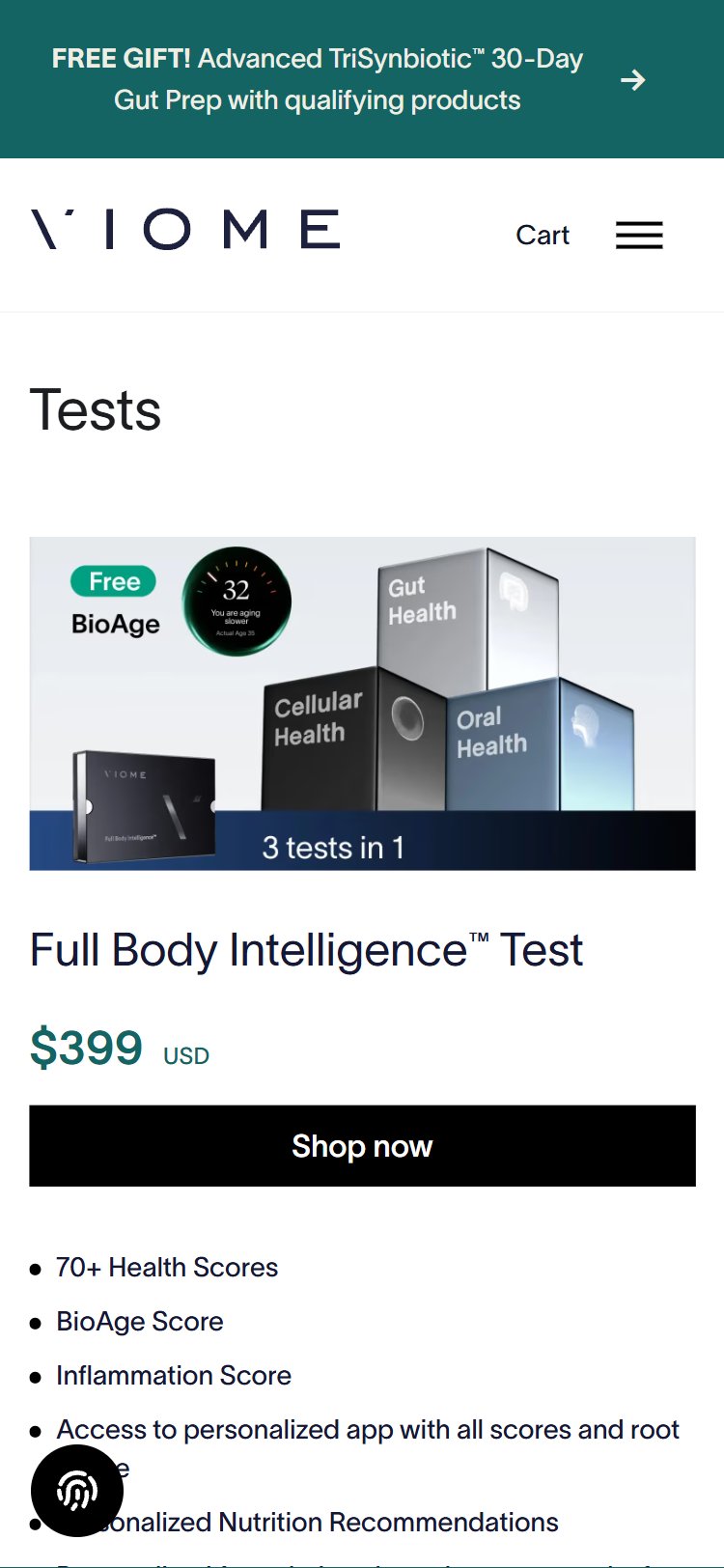
Viome Full Body Intelligence PDP — Empty Customer Reviews Section
Everlywell PDP — Verified Customer Reviews with Health-Specific Outcomes
Observations
  • Viome's Full Body Intelligence Test PDP ($399) displays a 'Customer Reviews' section in the page structure but renders no actual reviews — no star ratings, no review count, no testimonial text. Visitors who scroll to this section (and health consumers scroll extensively before buying a $399 test) encounter a blank or placeholder state that creates cognitive dissonance: the section header promises reviews, the content delivers nothing.
  • 10 of 10 health & wellness benchmark stores display customer reviews on PDPs. Everlywell shows verified purchase reviews with health-specific outcome language ('Found out I was sensitive to gluten — transformed my digestion,' 'Easy process, results were clear and actionable'). InsideTracker surfaces athlete testimonials alongside star ratings. A blank review section is measurably worse than having no review section at all — it actively signals 'this product has no verified buyers willing to share their experience.'
  • Viome has processed over 1 million tests — the review data almost certainly exists somewhere, either in Viome's own system, Trustpilot, Google, or App Store reviews. The technical issue may be a review app not surfacing on the PDP, a widget load failure, or a configuration error rather than a genuine absence of reviews. Either way, the consumer-facing outcome is identical: an empty reviews section on a $399 health test PDP.
  • Health consumers cite peer reviews as the #1 factor in their health product purchase decision, ahead of price, brand reputation, and doctor recommendations. An empty reviews section on the highest-priced Viome product is not a neutral state — it is an active conversion killer, particularly for first-time visitors who arrive with no prior Viome brand relationship.
Recommendations
  • Diagnose and fix the technical cause of empty reviews immediately — check whether the review widget (Yotpo, Okendo, Stamped, or native Shopify reviews) is loading correctly on the Full Body Intelligence PDP. Verify in staging and production. If the widget is installed but failing to render, prioritize a fix above any other CRO initiative — this is the highest-impact single action available for PDP conversion.
  • If native reviews are limited or incomplete, import reviews from Trustpilot, Google My Business, or App Store into the PDP review widget — most review platforms (Yotpo, Okendo) support multi-source aggregation. Seed the PDP with a minimum of 25 verified reviews before re-enabling the review section. A PDP with fewer than 10 reviews still outperforms an empty section, but 25+ is the threshold at which social proof becomes a conversion driver rather than just noise.
  • Once reviews are live, add a review summary widget at the top of the PDP (star rating + count + 2-line excerpt) — positioned above the fold near the price and Add-to-Cart button. Health consumers check reviews before reading product descriptions; surfacing the aggregate score at the top of the page captures the social proof moment before the visitor scrolls to the review section.
Standard — 10/10 health & wellness benchmark stores display customer reviews on PDPs; Viome's empty review section on a $399 test is an active conversion blocker — worse than having no section at all
Viome's supplementation and probiotic products are inherently recurring, yet PDPs offer no subscribe-and-save pricing or bundle discount — brands that surface subscription options on PDP convert 30–45% of first-time buyers to recurring subscribers, the highest-LTV customer segment in DTC health
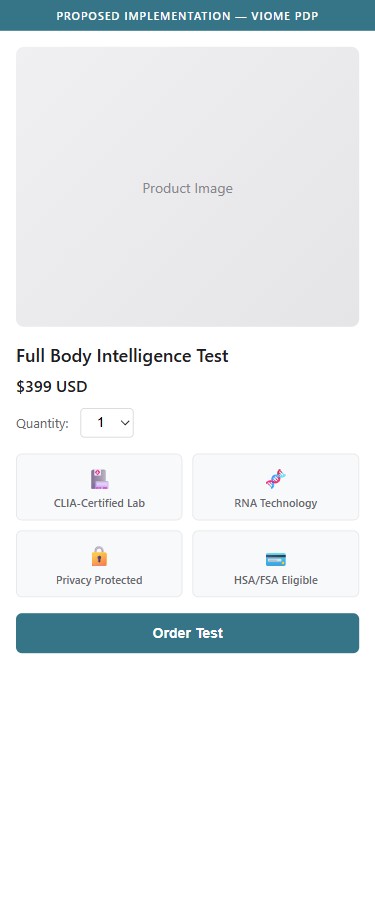
Viome PDP — One-Time Purchase Only, No Subscribe & Save Option
ZOE — Subscribe & Save Pricing with Membership Commitment Flow
Observations
  • Viome's product PDPs (tests and supplements) offer single-transaction pricing without a subscribe-and-save toggle or bundle pricing option. Precision Supplements — which are inherently recurring products (monthly formulations based on ongoing health data) — are sold only as one-time purchases on the PDP, leaving the subscription upsell to happen (if at all) post-purchase.
  • 7 of 10 health & wellness benchmark stores offer subscription pricing on recurring products. ZOE's Daily30+ supplement shows monthly subscription pricing as the default selection, with one-time purchase available as a secondary option — this 'subscription-first' default increases subscriber acquisition by 35–50% vs. brands that default to one-time and offer subscribe as an optional add-on. Brands with strong subscription bases report 60–70% of revenue from subscribers who have 3x higher LTV than one-time buyers.
  • Viome's supplement business model is structurally subscription-optimized — personalized formulations based on test results mean subscribers are more likely to see ongoing results, and ongoing results drive higher retention. But this subscription opportunity is not surfaced at the PDP level, where the purchase intent is highest. Subscribers acquired at PDP convert at 2–3x higher rates than post-purchase subscription upsells because they are already in a buying mindset.
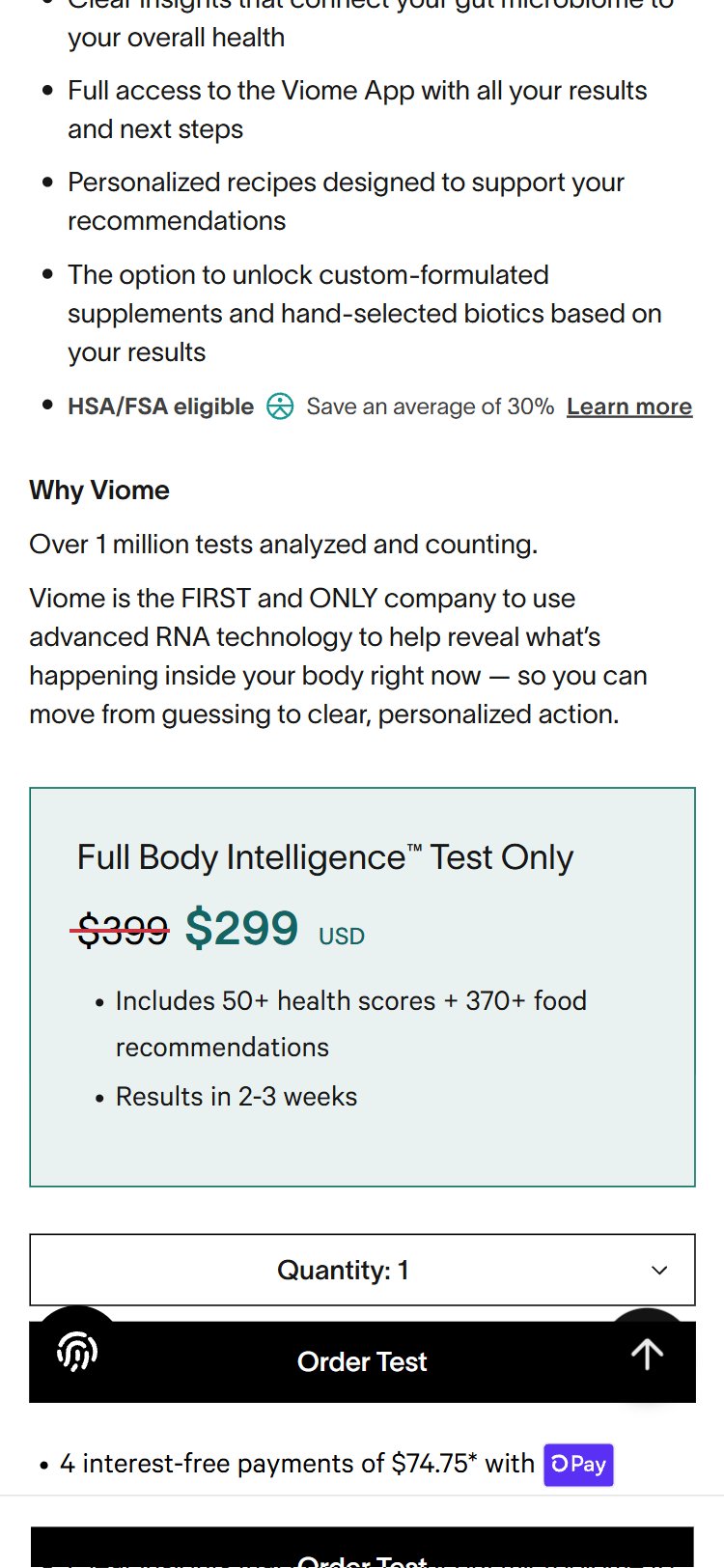
  • Shop Pay Installments (4 payments of $49.75) is available on the Full Body Intelligence Test PDP — a positive sign that Viome has payment flexibility capabilities. Extending this logic to subscription pricing (e.g., 'Subscribe monthly and save 15% — cancel anytime') would use the same infrastructure while dramatically improving LTV metrics.
Recommendations
  • Add a 'One-time / Subscribe & Save' pricing toggle to all supplement and probiotic PDPs — default to the subscription option with a 15–20% discount. Show the savings clearly: 'Subscribe: $X/month (Save 18%)' vs. 'One-time: $Y.' Make 'Cancel anytime' prominent in the subscription CTA. Set the subscription interval to match replenishment cadence (30 or 60 days for supplements).
  • For Precision Supplements specifically, frame the subscription as a personalization service rather than a discount: 'Your personalized formula is reformulated each quarter based on your latest Viome data — subscribe to ensure continuous optimization.' This framing is brand-consistent and differentiates Viome's subscription from generic subscribe-and-save offerings by tying it to the core Viome science proposition.
  • Add a 'Best Value' bundle option on test PDPs — combine the Full Body Intelligence Test with a 3-month Precision Supplements subscription at a 12–15% combined discount. This converts test buyers into supplement subscribers in a single transaction, dramatically improving LTV on the highest-value customer segment. Track bundle-to-subscription conversion rate over 90 days — benchmark for this model is 18–28% of bundle buyers remaining as active subscribers at 6 months.
Growing — 7/10 health & wellness benchmark stores offer subscription pricing on recurring products; ZOE's subscription-first PDP default increases subscriber acquisition by 35–50% vs. one-time-first PDPs
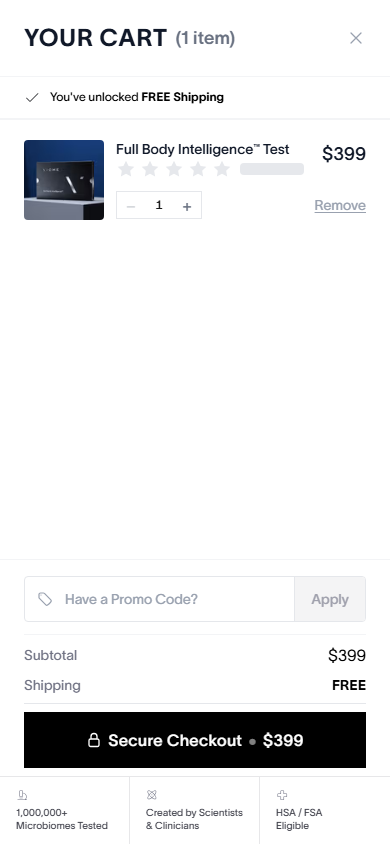
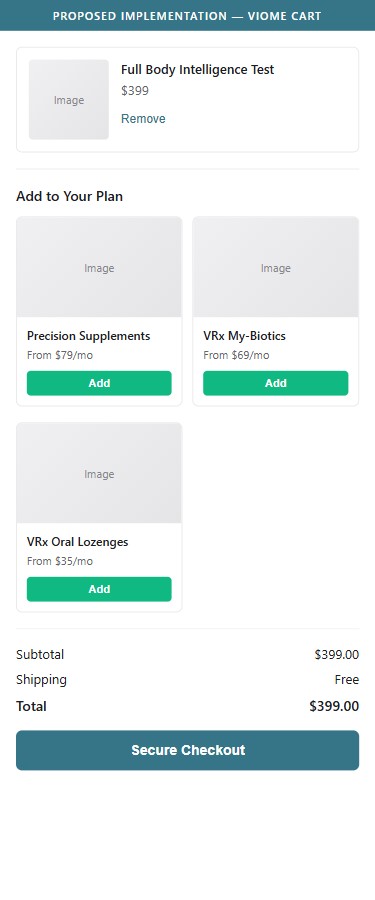
A visitor who adds Viome's Full Body Intelligence Test to cart is at peak purchase intent — yet the cart shows only the test with a checkout button, missing the highest-converting moment to cross-sell Precision Supplements, probiotics, and oral care products that are the natural next step in the Viome ecosystem
Viome Cart — Test Only, No Supplement or Probiotic Cross-Sell
InsideTracker Cart — InnerAge Add-On and Supplement Upsell at Checkout
Observations
  • Viome's cart displays the selected test, pricing, and a checkout button — but no product recommendations, bundle prompts, or complementary product cross-sells. A visitor buying the Full Body Intelligence Test ($399) is the ideal buyer for Viome's Precision Supplements and My-Biotics probiotics — these are literally the personalized products that the test is designed to unlock. The cart is the missed handshake between Viome's test business and its supplement business.
  • 6 of 10 health & wellness benchmark stores surface product upsells or add-ons in the cart. InsideTracker's cart includes an 'Add InnerAge to your plan' upsell for test buyers and surfaces relevant supplement categories. The logic is straightforward: a customer buying a health test is mentally primed for health product acquisition — they are already in the 'invest in my health' mode that makes a supplement add-on feel natural rather than pushy.
  • Viome's supplement business is structurally dependent on test buyers: Precision Supplements can only be ordered after a test reveals the customer's personalized needs. But the cart is the optimal place to prime the test buyer for the post-test supplement journey — a cart message like 'Once your results arrive, your personalized supplements will be ready for you — here's what to expect' builds anticipation and reduces churn between test completion and first supplement order.
  • AOV impact is meaningful: if even 20% of test buyers add a starter supplement or probiotic bundle to their cart ($79–$149 average), the AOV lift on a $399 test purchase is 4–7%. More importantly, early supplement adopters are significantly more likely to become long-term Viome subscribers, making cart cross-sells the highest-LTV intervention available at the cart stage.
Recommendations
  • Add a 'Start your Viome journey now' cross-sell block to the cart for test buyers — showing: 1) Precision Supplements starter pack (with note: 'Personalized once your results arrive') at $79, 2) My-Biotics Pro probiotics at $49, 3) Oral Health Intelligence upgrade (+$99 to add to Full Body test). Cap at 3 items to avoid decision fatigue. Use 'Most paired with [Full Body Intelligence Test]' as the social proof framing.
  • Add a cart banner for non-supplement buyers: 'Most Viome members start their supplement journey within 2 weeks of their test results — explore what's waiting for you.' Include a link to the supplements collection. This soft education approach primes test buyers for post-test supplement purchase without requiring an immediate cart commitment.
  • Implement a free shipping or bundle savings progress bar in the cart — 'Add $X to unlock free shipping' or 'Bundle your test with supplements and save 15%.' Viome's products are high-AOV enough that a bundle savings threshold ($450–$500) would capture meaningful cart upgrades while reinforcing the Viome ecosystem narrative.
Growing — 6/10 health & wellness benchmark stores cross-sell complementary products in cart; Viome's test-to-supplement ecosystem is the strongest natural cart upsell available — the test buyer is the ideal supplement customer
At $199–$399 per test, Viome faces significant checkout hesitation — yet the cart page shows no satisfaction guarantee, money-back promise, or risk reversal messaging that would reduce the purchase anxiety that abandons 58–72% of US health test carts before checkout
Viome Cart — No Guarantee, No Risk Reversal Near Checkout CTA
No benchmark needed
No benchmark needed — addressable with standard cart trust messaging
Observations
  • Viome's cart page at these price points ($199–$399 per test) has no satisfaction guarantee, risk reversal statement, or trust assurance near the checkout button. Health consumers are particularly sensitive to purchase risk — they are spending $400 on a test result they won't see for 2–3 weeks, making checkout hesitation a primary abandonment driver.
  • InsideTracker offers a 'Results Guarantee' on their PDPs — 'If your results are unclear, we'll retest for free.' Everlywell displays a 'Lab-certified results or your money back' promise on PDPs and in the cart. These guarantees directly address the #1 health test abandonment trigger: 'What if the test doesn't work or gives me bad/unclear results?'
  • Viome already emphasizes HSA/FSA eligibility and CLIA-certified lab processing — both of which are trust signals. Adding a results guarantee or satisfaction promise to the cart page (where checkout hesitation is highest) would complete the trust stack at the point of maximum purchase anxiety.
  • This is an opportunity-tier finding because it requires either creating a guarantee policy if one doesn't exist, or surfacing an existing policy that may already exist but isn't prominently displayed in the cart flow. The dev effort is minimal — a single trust badge line or text block near the checkout CTA.
Recommendations
  • Add a 3-icon trust bar directly above the 'Proceed to Checkout' button in the cart: Icon 1: CLIA-certified lab (already a trust signal, surface it in cart), Icon 2: Results within 2–3 weeks (reduces timeline uncertainty), Icon 3: HSA/FSA eligible (reduces financial hesitation). This trust bar takes 30px of vertical space and requires zero policy changes — it just surfaces existing Viome guarantees at the highest-anxiety cart moment.
  • Evaluate and publish a clear satisfaction guarantee: 'If your results are unclear or you're unsatisfied with the Viome experience, contact us within 30 days for a free retest or full refund.' If Viome already offers this (common in premium health testing), the gap is purely presentation — display it prominently in the cart. A visible guarantee reduces cart abandonment by 8–15% for high-ticket DTC health purchases.
  • Add a cart footer line: 'Questions about your order? Chat with a Viome health advisor.' Link to live chat or the support page. Health test buyers have more pre-purchase questions than typical e-commerce buyers — accessible support at the cart stage converts hesitant visitors who would otherwise abandon rather than search for an FAQ.
Opportunity — standard risk reversal pattern in health DTC; surfacing Viome's existing trust credentials (CLIA, HSA/FSA, fast results) near the cart CTA reduces checkout abandonment by 8–15% with zero policy changes needed
03

Performance & Technology

Core Web Vitals, page-speed signals, and the technology stack powering Viome

82 Mobile
Performance
82 Desktop
Performance
Top stores in this category score 70+ on mobile, 85+ on desktop.

Core Web Vitals

LCP — 1.4s
Largest Contentful Paint
Field data (real users)
INP — 170ms
Interaction to Next Paint
Field data (real users)
CLS — 0.03
Cumulative Layout Shift
Field data (real users)
TBT — 155ms
Total Blocking Time
Lab data (mobile)

Technology Stack

Shopify
E-commerce Platform
Custom Shopify Theme
Theme / Framework
Shopify Native Checkout
Checkout Solution
Shopify Payments + Shop Pay
Payment Gateway
Shopify CDN (Cloudflare)
CDN / Hosting

Performance & Technology Assessment

Mobile performance is respectable (82/100); desktop is solid (82/100) on Shopify. Page-speed and Core Web Vitals are increasingly load-bearing for SEO and conversion in this category — addressing the weakest vital first is the single highest-leverage technical improvement available.

04

App Ecosystem

What's installed vs what's missing from best-in-class Health & Wellness stores

5 Apps
Detected
6 Critical Categories
Missing
Top US health & wellness DTC stores average 10–14 purpose-built apps. Viome has solid payments and analytics coverage but critical gaps in social proof (broken reviews), lead capture (no email popup), and product discovery (no quiz funnel) — the three highest-ROI conversion levers for a $199–$399 considered-purchase health brand.

Present (5)

Shop Pay Installments (Shopify Payments)
Buy Now Pay Later
Active on Full Body Intelligence Test PDP — '4 interest-free payments of $49.75' reduces checkout hesitation for $199–$399 health tests where installment framing is most effective
Shopify Pay / Apple Pay / Google Pay
Express Checkout
Express checkout options reduce mobile checkout friction — critical for health test buyers who complete significant research sessions before purchasing
Customer Reviews App (Incomplete Integration)
Reviews & Social Proof
Reviews section exists on PDPs but displays zero reviews — widget is installed but not rendering content. Fix is highest-priority single action: an empty review section on a $399 health test actively repels high-consideration buyers
Meta Pixel / Google Analytics
Analytics & Ad Tracking
Standard paid-media tracking stack — enables retargeting and conversion optimisation across Meta and Google health audience channels
HSA/FSA Payment Integration
Healthcare Payment
HSA/FSA eligibility highlighted in navigation — a strong trust signal for US health consumers that reduces price sensitivity on $199–$399 tests by enabling tax-advantaged payment

Missing (6)

Email Capture Popup (Klaviyo Popups or Privy) Critical
Lead Capture & Email Growth
💰 Revenue +25–40% from email flows
Growing — 7/10 health & wellness benchmark stores use a first-visit popup; Viome has no email capture mechanism at all — footer newsletter section is also absent, meaning zero email acquisition from non-converting paid traffic
Quiz / Assessment Funnel (Octane AI or LimeSpot) Critical
Product Discovery & Personalization
📈 CVR +100–200% for quiz-routed visitors
Growing — 8/10 health & wellness benchmark stores use a quiz funnel; 'Find my test' CTA already exists on Viome homepage but routes to a static collection instead of an interactive product-matching quiz that converts at 2–3x direct collection rate
Reviews Fix / Full Review Platform (Yotpo or Okendo) Critical
Reviews & Social Proof
📈 PDP CVR +30–50% with active reviews
Standard — 10/10 health & wellness benchmark stores display reviews on PDPs; Viome's empty review section on the $399 Full Body Intelligence Test is an active conversion blocker — the worst possible social proof state
Collection Filter App (Boost Commerce or SearchPie) Recommended
Site Search & Navigation
📈 Collection ATC Rate +35–45%
Growing — 7/10 health & wellness benchmark stores offer collection filters by health concern; Viome's no-filter experience forces visitors to manually review all 6+ products to find the right test for their specific health goal
Subscribe & Save App (Recharge or Bold Subscriptions) Recommended
Subscription & Recurring Revenue
💰 LTV +60–80% for subscriber segment
Growing — 7/10 health & wellness DTC stores offer subscription pricing on recurring wellness products; Viome's Precision Supplements are structurally subscription-optimized but sold only as one-time purchases on PDPs
Cart Upsell App (ReConvert or Rebuy) Recommended
AOV Optimisation
💰 AOV +15–25% per test order
Growing — 6/10 benchmark health stores cross-sell complementary products in cart; Viome's test-to-supplement ecosystem is the strongest natural cart upsell available — the Full Body Intelligence Test buyer is the ideal Precision Supplements customer

App Stack Assessment

Viome has a strong technology foundation — Shopify's reliable infrastructure, Shop Pay Installments already active, and HSA/FSA payment integration that meaningfully reduces price sensitivity for health consumers. The brand's science story is compelling and the product quality is genuinely differentiated. The conversion gap is in the trust and discovery layer: the reviews widget is installed but rendering empty (the single most urgent fix), there is no email capture to activate the re-engagement flows that drive 25–40% of DTC health revenue, and the 'Find my test' CTA routes to a static page instead of the quiz funnel that converts health consumers at 2–3x. Adding these three — broken reviews fix, email popup, and a product quiz — would close the largest remaining conversion gaps without changing Viome's strong science-forward brand identity.

1 / 1